Technical guide
Reflectometric pyrometry: measuring true temperature without knowing emissivity
A pyrometer measures the temperature of a surface remotely, from the radiation it emits. But that radiation also depends on the surface's emissivity, which changes when a metal oxidizes, melts or changes appearance. Reflectometric pyrometry measures emissivity in real time: the temperature is calculated automatically, with no user adjustment, and the measurement shows the state of the target live. This guide explains the principle, compares it with conventional pyrometers and helps you choose.
- Max. temperature (ThermoRef HT)
- 3000 °C
- User adjustment
- None
- Accuracy
- ± 10 °C at 1500 °C
- Emissivity
- Measured continuously
How does a pyrometer measure temperature?
Every hot body emits radiation whose intensity depends on its temperature: this is Planck's law. An optical pyrometer captures this radiation with a photodiode, in a given wavelength band, and derives the temperature from it. It measures without contact and from a distance, on objects that are very hot, moving or out of reach.
But a real surface emits less than an ideal black body. The ratio between the two is called emissivity: close to 1 for a highly absorbing surface, much lower for a shiny metal. The pyrometer needs to know it to display the right temperature.
Yet emissivity is not a constant of the material. It depends on wavelength, temperature and above all on the surface condition. A part that oxidizes, melts, is polished or changes roughness changes emissivity during the measurement.
Why emissivity skews the measurement
- Emissivity set once and for all. On a single-color pyrometer, emissivity is set by hand, often by comparing with a thermocouple at a known temperature. But a thermocouple never gives exactly the surface temperature, and this adjustment is impossible on a moving part.
- Emissivity that changes during the measurement. If the surface oxidizes or changes appearance, the real emissivity drifts from the set value and the displayed temperature becomes wrong, with nothing to flag it.
- Metals are the most affected. Their emissivity is low and very sensitive to surface condition: slight oxidation is enough to change it significantly, and therefore to skew the measurement.
The two-color pyrometer and its limits
To get around the problem, the two-color pyrometer (or ratio pyrometer) measures radiation at two wavelengths and calculates their ratio. If emissivity is the same at both wavelengths, it cancels out of the calculation: this is the gray-body assumption.
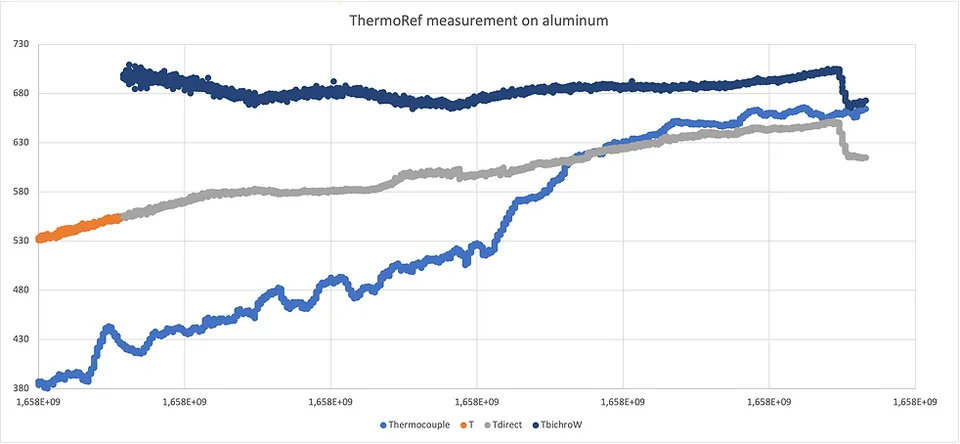
This assumption suits some materials, but not many metals, whose emissivity varies with wavelength. It also breaks down when the surface oxidizes. The two-color temperature then drifts, as shown by the aluminum test below.
Measuring emissivity through reflection
Another approach is to measure emissivity instead of assuming it. For an opaque surface, light that is not reflected is absorbed, and a good absorber is a good emitter (Kirchhoff's law): emissivity equals 1 minus reflectivity.
An emissivity-correcting pyrometer therefore lights the target with its own source, measures the reflected light and derives the emissivity continuously.
But it captures reflection in a single direction only. A matte surface scatters light in all directions, while a shiny surface reflects it like a mirror. This matte or shiny character, called the diffusion factor, has to be set at the start. If it changes, for example when a metal oxidizes, the correction becomes wrong.
Two-color reflectometric pyrometry
The ThermoRef combines both previous approaches and adds the missing piece: it calculates the diffusion factor instead of setting it. A measurement takes four steps:
- 1
Two radiances
Two photodiodes measure the radiation emitted by the target, at 1.3 and 1.5 µm.
- 2
Two reflectivities
Two lasers at the same wavelengths light the target, and the ThermoRef measures the share reflected at each.
- 3
Diffusion factor
By combining the measurements, and assuming the surface reflects light the same way at two close wavelengths, the calculation determines the diffusion factor.
- 4
True temperature
Emissivity is corrected in real time and the ThermoRef displays the pyroreflectometric temperature, along with the single-color and two-color temperatures for comparison.
Independent of the viewing angle. The combined calculation is designed not to depend on the measurement angle, which makes installation easier.
Emissivity your other instruments can use. The ThermoRef displays the measured emissivity, which you can enter into an infrared camera or a single-color pyrometer.
An optical head connected by fiber. The measuring head is connected to the electronics by an optical fiber (2 m as standard): the measurement is not disturbed by electromagnetic fields, such as those of induction heating.
An active view of the target, with nothing to adjust
A conventional pyrometer is passive: it measures the radiation of whatever is in its field of view and applies a coefficient chosen by the user. The ThermoRef lights the target and continuously analyzes what comes back. This changes two things in the field.
-
You see the target change
Reflectivities, emissivity and diffusion factor are measured in real time: you follow the target's change of state live, such as oxidation, delamination or perforation. The measurement tells you as much about the condition of the part as about its temperature.
-
No target, no measurement
If the beam misses the target, or if the target is perforated, the reflected signal disappears and the ThermoRef gives no temperature. A passive pyrometer always displays a value, whatever it is pointed at.
-
No adjustment, no tweaking
The temperature is calculated automatically from the measurements. There is no emissivity coefficient to enter: nobody can adjust the displayed value to match an expectation, and the result does not depend on the operator.
-
A measurement you can justify
Temperatures, reflectivities and emissivity are recorded together, on an SD card or in the PC software: every value can be explained afterwards.
Which pyrometer for which situation?
| Single-color | Two-color | Emissivity-correcting | Two-color reflectometric (ThermoRef) | |
|---|---|---|---|---|
| Emissivity | Set in advance | Assumed identical at both wavelengths | Measured, with a fixed diffusion factor | Measured, diffusion factor calculated |
| Surface that oxidizes or changes appearance | Error | Error if emissivity does not change the same way at both wavelengths | Error if the surface becomes more matte or shinier | Corrected in real time |
| User adjustment | Emissivity to enter | Emissivity ratio, for a non-gray body | Diffusion factor to set | None: temperature calculated automatically |
| Information on the target's condition | None | None | Reflectivity, in one direction only | Reflectivities, emissivity and diffusion in real time: oxidation, delamination, perforation |
| If the aim leaves the target | Measures whatever is in view | Measures whatever is in view | Depends on the instrument | No reflected signal: no temperature |
| Instrument | Simple and inexpensive | Simple | Built-in light source | Two lasers and on-board calculation: more complete |
| Best for | Known material, stable surface | Gray bodies, partially obscured target | Surface with stable appearance | Changing surfaces: oxidation, melting, mixed materials |
Example: melting an aluminum plate
On an aluminum plate heated until it melted, the ThermoRef was compared with a thermocouple and with the two-color temperature. The two-color temperature stays several tens of degrees higher, while the ThermoRef reading is the closest to the thermocouple.
At first, the gap with the thermocouple is due to the thermocouple's poor contact with the metal. At around 580 °C, when the aluminum starts to melt, the thermocouple sinks in, contact becomes perfect and the two readings converge.
Applications
-
Oxidizing metals
Metal parts whose surface oxidizes during heating: the measurement stays reliable despite the change in appearance.
Learn more -
Induction heating
The optical head and the fiber are not disturbed by the inductor's electromagnetic fields.
Learn more -
Very-high-temperature materials
Graphite, multi-material parts, furnace tests: up to 3000 °C with the ThermoRef HT.
Learn more -
Quality control
Monitoring the surface condition of molds or parts under high thermal stress: oxidation, delamination, perforation.
-
Calibrating other instruments
Providing the right emissivity to an infrared camera or a single-color pyrometer.
-
Moving objects
Non-contact measurement on moving or rotating parts, where a thermocouple is impossible.
-
Furnaces and enclosures
Remote measurement in confined and harsh environments, such as an industrial furnace.
Learn more
What to know before choosing
- An opaque target. The method relies on the relationship between emissivity and reflectivity, which holds for opaque surfaces. A semi-transparent material needs a specific study.
- An assumption, but a less restrictive one. The method assumes the surface reflects light the same way at two close wavelengths. This is far less restrictive than the gray-body assumption, but it is still an assumption.
- Calibration sets the accuracy. The ThermoRef is delivered with a pyrometric and reflectometric calibration, which can be redone later: it determines the accuracy of the measurements.
- Class 3B lasers. Installation requires the usual precautions for this type of laser. The measurement lasers can be switched off from the software, and the aiming laser is class 2.
- The electronics stay cool. The electronic unit operates between 15 and 30 °C: only the optical head, connected by fiber, goes near the hot area.
How to choose a pyrometer
Five questions to tell whether a reflectometric pyrometer suits you, and which one:
- 1
Does the surface change during the measurement?
If so (oxidation, melting, mixed materials, a part that degrades), a reflectometric pyrometer is the safest choice. On a stable, well-known surface, a properly set single-color pyrometer may be enough.
- 2
What temperature range?
ThermoRef Standard: 500 to 1500 °C. ThermoRef HT: 750 to 3000 °C. The lower limit depends on the target's emissivity: on a black body, measurement is possible from 400 °C.
- 3
What distance and target size?
Measurement distance of 200 mm as standard, 100 mm to 1.5 m on request. The measurement spot is 4 mm at 200 mm as standard, and 1 to 30 mm depending on distance and fiber.
- 4
What measurement rate?
10 measurements per second as standard, up to 100 on request.
- 5
How will you use the data?
4-20 mA and 0-10 V outputs to your PLC or acquisition system, Ethernet and PC software for remote control, a 7-inch touchscreen and SD card recording.
ThermoRef pyrometers
| Model | Temperature | Accuracy | Measurement rate | Weight |
|---|---|---|---|---|
| ThermoRef Standard | 500 – 1500 °C | ± 10 °C at 1500 °C | 10 Hz (100 Hz on request) | 2.5 kg |
| ThermoRef HT | 750 – 3000 °C | ± 10 °C at 1500 °C | 10 Hz (100 Hz on request) | 3 kg |
Values taken from the brochure and product pages. Both models measure at 1.3 and 1.5 µm. The ThermoRef HT has more powerful lasers for high temperatures. The ThermoRef BT (150 – 500 °C) is no longer in the catalogue.
Frequently asked questions
What is emissivity?
It is the ratio between the radiation emitted by a surface and that of an ideal black body at the same temperature. It ranges from 0 to 1 and depends on the material, wavelength, temperature and surface condition.
What is the difference between a single-color and a two-color pyrometer?
A single-color pyrometer measures radiation at one wavelength and requires the emissivity to be known. A two-color pyrometer measures at two wavelengths and takes their ratio: emissivity cancels out, provided it is the same at both wavelengths (gray body).
Is a two-color pyrometer enough on an oxidizing metal?
Not always. Many metals do not behave like gray bodies, and oxidation changes their emissivity differently depending on wavelength. The two-color temperature can then drift, as in our aluminum test.
Does the ThermoRef measure emissivity?
Yes. It continuously measures the target's reflectivity at two wavelengths, derives the emissivity and displays it. You can enter it into an infrared camera or another pyrometer.
Can the displayed temperature be adjusted or corrected?
No. The ThermoRef calculates the temperature automatically from the measured radiances and reflectivities: there is no emissivity coefficient to enter. The result does not depend on the operator and cannot be tweaked to match an expected value.
What happens if the pyrometer misses the target?
The reflected laser signal disappears and the ThermoRef gives no temperature. This is a safeguard: a passive pyrometer would measure whatever is behind without any warning. The same effect shows that a target has been perforated.
From what temperature does the ThermoRef measure?
From 500 °C for the ThermoRef Standard and 750 °C for the ThermoRef HT. The lower limit depends on the target's emissivity: on a black body, measurement is possible from 400 °C.
Can it be used with induction heating?
Yes. The optical head is connected to the electronics by an optical fiber, which is not disturbed by the inductor's electromagnetic fields.
How large is the measurement spot?
4 mm at a distance of 200 mm as standard. Depending on the distance (100 mm to 1.5 m) and the chosen fiber, it ranges from 1 to 30 mm.
How is the ThermoRef integrated into an installation?
It has 4-20 mA and 0-10 V outputs for a PLC or acquisition system, an Ethernet link with PC software for remote control, a touchscreen and SD card recording.
A surface temperature that is hard to measure?
Tell us about the part, the material, the temperature range, the distance and the environment: we will tell you whether the ThermoRef is suitable and how to install it.
Read also: Materials research · ThermoRef use cases · Guides