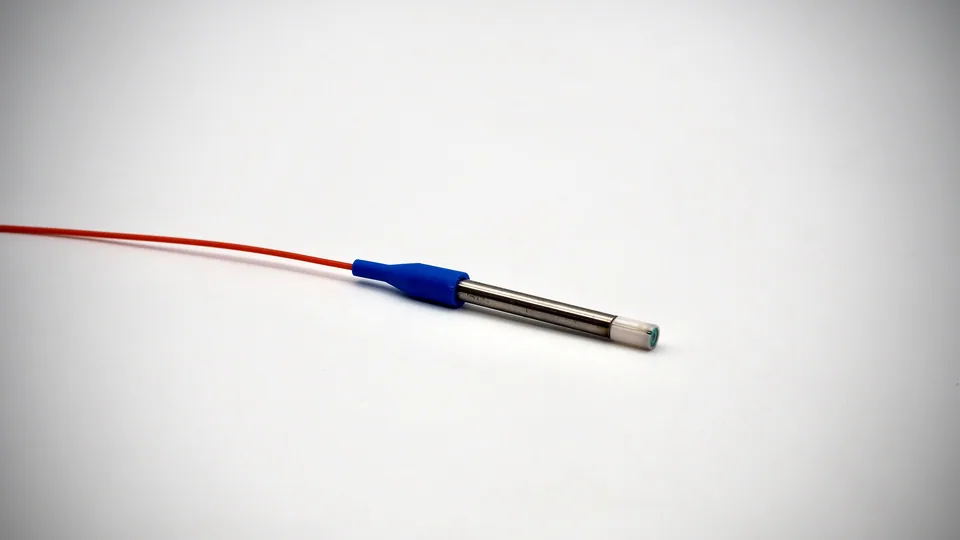
Alpheus Standard
- Resonance frequency
- 30 kHz – 1 MHz
- Bandwidth
- up to 400 kHz
- Max. permissible pressure
- up to 220 dB SPL
- Diameter
- down to 1.6 mm
This sensor has been designed for use in harsh environments, offering high sensitivity and a wide bandwidth. It is fully calibrated for sensitivity and frequency bandwidth.
Thanks to its compact size, it enables the study of high-frequency acoustic waves in ducts.
Typical applications:
Turbine analysis (compressor stall analysis)
Non-destructive testing
High-voltage measurements (overhead lines, electrical transformers)
Arc or high-frequency welding processes
Measurements in ATEX environments
Guide: all about the fiber-optic microphone
Main features
Resonance frequency: from 30 kHz to 1 MHz. Typical values: 70 kHz, 100 kHz, 150 kHz, 200 kHz, 400 kHz.
High‑pass frequency: typically 100 Hz.
±3 dB bandwidth: one‑third of the resonance frequency.
Sensor sensitivity: varies with resonance frequency, ranging from 1 µV/Pa to 5 mV/Pa.
Maximum permissible pressure: from 130 dB to 220 dB SPL.
Dynamic range: typically 60 dB with microMyotis, 80 dB with Myotis Standard, 100 dB with miniMyotis.
Examples of sensors in stock:
Alpheus70
Alpheus100
Alpheus400
Operating temperature: from -40 °C to +125 °C.
Operating ambient pressure
Front‑vented sensor
Highlights:
- Excellent sensitivity and wide bandwidth (up to 400 kHz), ideal for high‑frequency acoustic analysis.
- Robust design for harsh environments: extreme temperatures (-40 °C to +350 °C), 100 % humidity, and EMI/RFI resistance.
- Very diverse applications: turbine analysis, non‑destructive testing, high‑voltage measurements, ATEX environments, arc or HF welding.
- Advanced miniaturization: its reduced diameter (down to 1.6 mm) makes it well suited for confined or hard‑to‑reach environments.
- Factory calibration: each sensor is delivered ready to use, ensuring reliable performance.
Use cases
Use cases for the Alpheus Standard sensor
- Industrial turbine analysis
- Purpose: monitor blade integrity or detect mechanical defects via acoustic analysis.
- Benefit: sensor can be placed close to the airflow or inside a housing without electromagnetic interference.
- Example: hydroelectric plants, aviation, gas turbines.
- Non‑destructive testing (NDT)
- Purpose: detect microcracks, delaminations, or mechanical stress in materials.
- Benefit: very wide bandwidth (up to 400 kHz) and fast response.
- Example: weld inspection, composite part testing, aircraft hull inspection.
- Measurements in high‑voltage or strong magnetic‑field zones
- Purpose: acquire acoustic data in electrically noisy environments.
- Benefit: complete immunity to EMI/RFI (no metal conductors).
- Example: transformers, high‑voltage lines, superconducting coils.
- Monitoring arc or high‑frequency welding processes
- Purpose: real‑time quality control or acoustic defect detection during welding.
- Benefit: small form factor plus good thermal tolerance and measurement stability.
- Example: welding robots, automotive or aerospace manufacturing.
- ATEX environment applications
- Purpose: acoustic monitoring in explosive‑atmosphere zones (petrochemical, gas, mining).
- Benefit: passive sensor requiring no active electrical power.
- Example: gas leak detection, abnormal noise monitoring in secured areas.
- Diagnostics in ducts or closed structures
- Purpose: study acoustic propagation or resonance in narrow channels.
- Benefit: ultra‑small diameter (down to 1.6 mm) and fully dielectric sensor.
- Example: medical instruments, flow analysis in tubes, MEMS devices.
Compare the Alpheus range
| Alpheus StandardThis product | Alpheus HT | Alpheus THT | Alpheus UHT | |
|---|---|---|---|---|
| Frequency band | up to 400 kHz | 100 Hz – 100 kHz | 100 Hz – 400 kHz | 1/3 of resonance frequency |
| Resonance frequency | 30 kHz – 1 MHz | > 100 kHz | — | 30 kHz – 1 MHz |
| Operating temperature | see datasheet | −40 → 350 °C (420 °C peak) | −40 → 800 °C (850 °C peak) | −40 → 850 °C |
| Max. pressure | 130 – 220 dB SPL | 190 dB SPL (dynamic) | 203 dB SPL (dynamic) | 130 – 220 dB SPL |
| Sensitivity | 1 µV/Pa – 5 mV/Pa | 0.3 mV/Pa | 1.5 µV/Pa | 1 µV/Pa – 5 mV/Pa |